
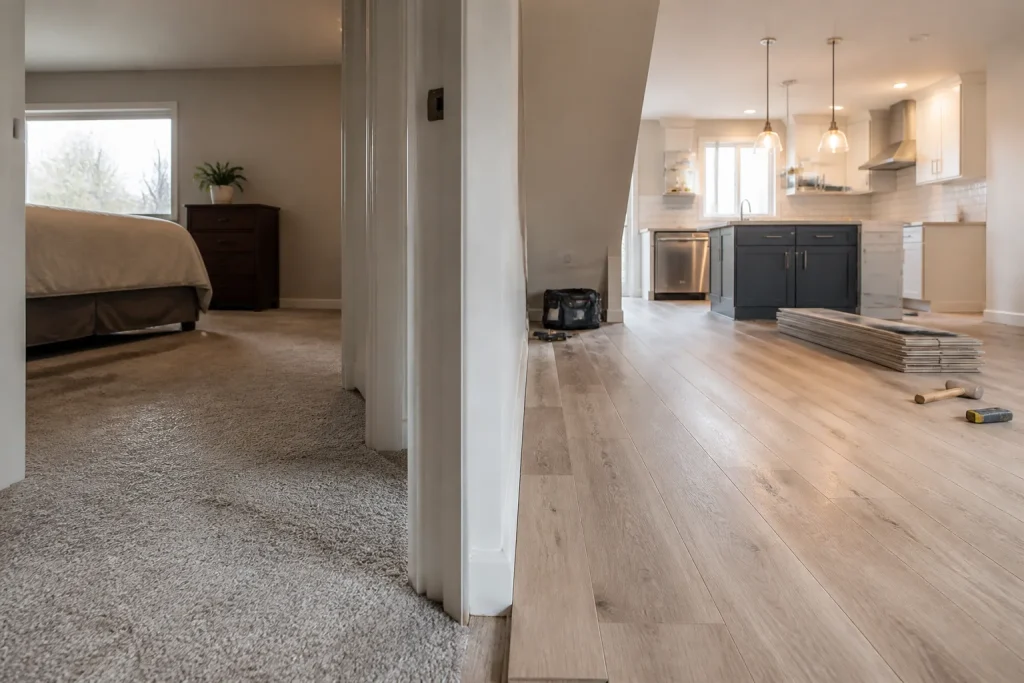
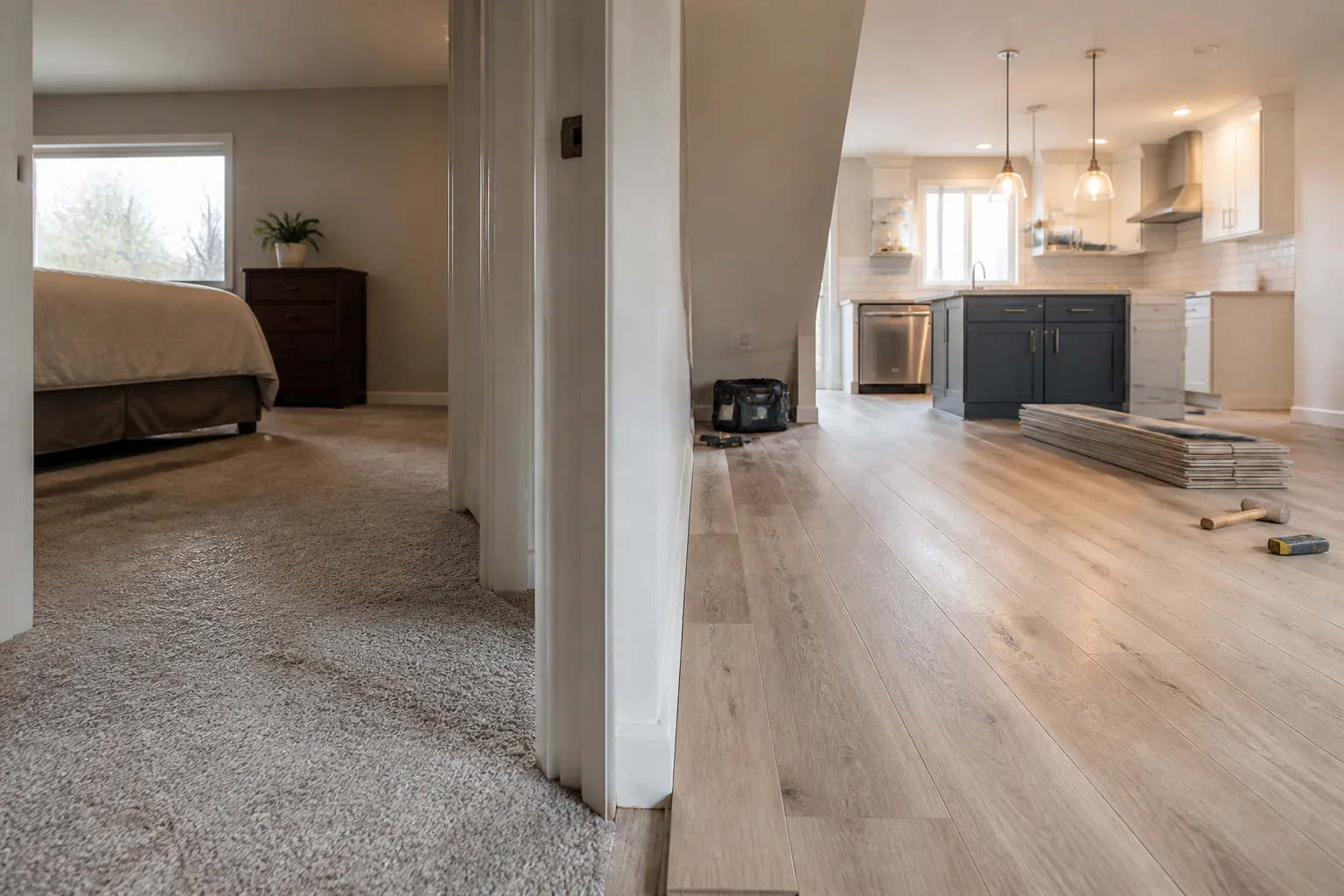
Carpet or Hard Flooring for a Bedroom: How to Decide
Most people ask the bedroom flooring question backwards. They start with how the floor will look, then try to make it work for how they sleep, clean, and move through the room. Flip it. Three things decide the answer before a single product is picked: who sleeps in the room, how hard the room gets used, and what your slab, subfloor, and HVAC setup will actually support. Answer those honestly and the material choice usually settles itself. If you’d rather have someone walk the room with you, call (888) 515-5223.
Start With the Room, Not the Showroom
Bedrooms are the most misunderstood rooms in flooring. A kitchen asks for water resistance. A hallway asks for wear. A bedroom asks for three things that don’t show up on a spec sheet: comfort underfoot, quiet, and low maintenance for the person who owns that room. Get those right and the material decision is almost automatic.
Here’s how that plays out in practice. The primary bedroom usually belongs to adults who are up early, walk on the floor barefoot, and want the room to feel calm. A room occupied by a teenager needs to survive dropped phones, nail polish, spilled drinks, and a general refusal to take shoes off. A guest room sits empty most of the year and only needs to look good and clean up fast. Those are three different rooms with three different answers, even if they sit on the same hallway.
Then there’s the part nobody mentions at the design stage: what’s under the floor. North Las Vegas homes tend to sit on slab, and slab temperature drives how a floor feels in the morning far more than most people expect. A floor chosen purely on looks can feel wrong the first cold morning. Start with the room’s function and your slab, and the product conversation gets short.
The Acoustic Reality of a Second-Story Bedroom
If the bedroom is upstairs, sound matters more than any other single factor. Hard flooring in a second-story bedroom transmits footfall impact to the room below, and most people underestimate the effect until they’re living over it. Carpet and a quality carpet cushion absorb much of that impact. Hard surfaces flex, transfer, and reflect it.
Underlayment can help, but only to a point. An acoustic underlayment built for hard flooring improves impact performance meaningfully compared with a bare hard floor, and it’s worth specifying for any upstairs bedroom. What it can’t do is match a carpeted floor with a proper cushion. Impact noise travels through the floor assembly, so no pad completely removes the difference between a soft and a hard surface.
- Carpet with a cushion: the quietest option for the room below and the room above. This is the practical reason many upstairs bedrooms stay carpeted even in homes with hard flooring everywhere else.
- Hard flooring with a dedicated acoustic underlayment: noticeably better than a bare hard floor and often enough for a secondary bedroom, but not equal to carpet.
- Hard flooring without acoustic underlayment: the loudest choice, and the one most likely to generate complaints from whoever lives downstairs.
For a second-story bedroom in North Las Vegas, the honest framing is this: if noise below is a real concern, carpet wins. If you want hard surface upstairs, specify the acoustic underlayment and accept that it’s a partial fix, not a match.
Allergen Tradeoffs, and Why They Cut Both Ways
Carpet traps allergens. That’s true, and it’s also roughly half the story. Carpet holds dust, pollen, and pet dander down in the pile rather than letting them lift into the air every time someone walks across the room. If you vacuum it consistently with a decent filter, it keeps those particles out of the breathing zone, which is the air a person actually inhales while sleeping.
Hard flooring keeps allergens visible. Dust shows up on the surface where you can see it and wipe it away, and for some people that visibility is a real advantage. But hard floors also let fine particles stay airborne longer. Foot traffic and HVAC airflow push dust around the room more easily over a hard surface than over a carpet that’s catching it.
So the right answer depends on who sleeps there:
- A bedroom in a household with allergies, asthma, or pets: hard flooring with regular damp dusting is usually easier to keep up with, especially if a robot vacuum runs often. Carpet can work too, but only with consistent vacuuming and prompt attention to spills.
- A bedroom with no specific respiratory concern: either surface is fine. Carpet’s trapping effect is generally not a problem when it’s cleaned regularly.
- A bedroom where cleaning gets skipped during busy weeks: hard flooring is more forgiving of inconsistency. Carpet punishes a few missed vacuum cycles more visibly.
What we tell people in North Las Vegas is simple: pick the surface you’ll actually maintain, not the one that sounds ideal in theory.
Cold Mornings, Slab, and Why Radiant Heat Rarely Makes Sense Here
North Las Vegas homes sit on slab more often than not, and slab runs cold overnight even in a mild winter. A thermostat reading around 70°F does not mean the tile in your bathroom feels like 70°F. Tile and luxury vinyl plank over concrete hold that cold and hand it back to bare feet in the morning. Carpet insulates you from the slab, which is why the first step out of bed feels completely different on carpet than on tile.
Radiant heat is the obvious sounding fix. In a single bedroom, it usually isn’t worth the cost. Retrofit systems mean lifting the floor, adding a heating element, and reinstalling, and the upfront cost runs well past the comfort gain on one room. There are cheaper ways to close the gap:
- A large area rug beside and under the bed, which protects the cold-foot moment without touching the slab.
- A quality underlayment under hard flooring, which adds a bit of insulation and a lot of acoustic benefit.
- Carpet in the primary bedroom and hard flooring in secondary rooms, if the morning cold only bothers the person who wakes first.
If the room has a newer or well-insulated slab, the difference shrinks. If it’s an older home with a cold floor most of the winter, plan accordingly before you pick a surface.
Match the Surface to Who Sleeps There
This is where the decision stops being abstract. In our experience, homeowners who walk into the decision room by room make fewer regrets than those who pick one floor for the whole upstairs.
The primary bedroom
Comfort, warmth, and quiet lead. Carpet wins most of these conversations, and Shaw and Mohawk carpet lines cover the range from a plush soft pile to a tighter loop that wears better. If the primary bedroom goes hard surface, plan on a generous rug and dedicated acoustic underlayment.
A teenager’s room
Durability leads. Scratch and stain resistance matter more than warmth. Luxury vinyl plank from COREtec or LifeProof holds up to dropped items and quick cleanups, and water resistance on the surface is a real advantage in a room where a beverage will eventually go over. Carpet can work here too, but choose a tight, stain-resistant construction rather than something plush. Carpet needs fast attention to spills either way.
A guest room
Use determines everything. A room that sits empty most of the year needs to look good, clean up fast, and not cost much per square foot to do it. Hard surface makes sense for a rarely used room, especially if it doubles as an office or a play space. Wall-to-wall carpet also works if it’s the only room upstairs that stays quiet and warm. Match it to the rest of the hallway and the room stops feeling like an afterthought.
The Hybrid Answer Most Guides Skip
Here’s the option that solves the carpet-versus-hard question without forcing a permanent pick: hard flooring throughout the bedroom, plus a large area rug under and beside the bed. You get the cold-foot comfort in the morning, the acoustic benefit where foot traffic actually lands, and a surface you can clean in five minutes. You also keep the option open to change the rug as tastes shift, which wall-to-wall carpet doesn’t offer.
Where it works best:
- You want the look of hard flooring and the feel of carpet where it matters.
- You have pets or kids and want a washable, replaceable layer on top of a durable floor.
- You’re not sure you’ll stay in the house long and want flexibility later.
Where the hybrid loses: if the upstairs bedroom is over a room where quiet matters, a rug on hard flooring is quieter than a bare hard floor but not as quiet as full carpet with cushion. And the rug is not permanent, which is the point and also the drawback. If the room needs to be warm and quiet no matter what, wall-to-wall carpet with a quality cushion is the correct call. If you want the surface you can clean fast and the rug you can swap, hard flooring plus a rug gets you most of the benefit and more flexibility. That’s a real tradeoff, and worth naming at the estimate.
When to Call a Pro
If the room is small, a hard floor over a flat, dry slab is within reach of a careful DIYer. If any of the following apply, get an installer in the room:
- The subfloor has bounce, humps, or visible cracks that could telegraph through a rigid surface.
- You’re installing over an older home where the slab moisture situation hasn’t been checked.
- You’re going upstairs, where the acoustic underlayment and stair transitions are the part most DIYers get wrong.
- You want carpet stretched and seamed properly, which is the difference between a floor that looks good in year one and one that does in year ten.
We install carpet and tile, and we refinish existing hardwood. That covers all three of the bedroom conversations above without handing you off between contractors. Our technicians have up to 12 years of experience, and we bring nine brands to the estimate so the decision is yours, not ours. If you’re in North Las Vegas and want a second opinion on the room before you commit, that’s what the visit is for.
Related services in North Las Vegas: carpet installation for the soft-surface rooms, tile flooring installation for bedrooms that double as baths, or laundry adjacencies, and hardwood refinishing if you’re keeping what’s already underfoot. If you’re still evaluating whole-home options, start with our overview of flooring installation in North Las Vegas, and see how we approach area decisions on our North Las Vegas page.
The Bottom Line
Carpet wins the bedroom when comfort, warmth, and quiet lead: the primary bedroom, upstairs rooms over a living space, and any room where bare feet hit the floor first thing. Hard flooring wins when durability, easy cleanup, and allergy management lead: a teenager’s room, a guest room that doubles as an office, and rooms where the occupants want to dust and go. When both apply, hard flooring with a large rug is a legitimate middle path, as long as you accept the acoustic compromise. Pick the room’s function first, then the product, and the choice usually makes itself obvious.
If you’re in North Las Vegas and need help deciding, Flooring Installation North Las Vegas offers free estimates. Call (888) 515-5223. We answer 24/7, with fast dispatch from 7am to 7pm, Sunday through Friday. Every written estimate sets the final price, and the visit is free.
Frequently Asked Questions
It depends on the room. Carpet is better for warmth, comfort underfoot, and quiet, especially in an upstairs bedroom over a living space. Hard surface is better for cleanup, durability, and allergen management. If the room belongs to an adult who wants a warm floor and quiet, carpet usually wins. If the room belongs to a teenager or doubles as a home office, hard flooring wins. Call (888) 515-5223 for an exact recommendation on your room; the estimate is free.
Yes, more than carpet does. Footfall impact transmits through a second-story floor assembly, and hard surfaces are noisier for the room below. A dedicated acoustic underlayment closes a good part of the gap, but carpet with a quality cushion remains quieter. If quiet is the priority, carpet wins. If loudness is tolerable but you want hard surface, specify the underlayment. Call (888) 515-5223 to talk through your floor assembly.
Not automatically. Carpet traps allergens in the pile and keeps them out of the air you breathe while you sleep, and consistent vacuuming handles that. Hard floors keep dust visible and surface-cleanable but let fine particles stay airborne longer with foot traffic and HVAC airflow. The right answer depends on the occupant: for a bedroom in a household with significant allergies, hard flooring is usually easier to keep up with. Call (888) 515-5223 for a free estimate if you’re weighing it.
Yes, with a large area rug and a quality underlayment under the hard surface. Slab-based homes stay cold through the winter regardless of thermostat readings, and radiant heat retrofits in a single bedroom rarely pay off. The rug handles the morning cold-foot moment; the underlayment helps slightly and adds acoustic benefit. On a bedroom where warmth is the priority, carpet is the simpler answer. Call (888) 515-5223 for a free estimate on your options.
Written by the team at Flooring Installation North Las Vegas.
Need Flooring Help?
Call Flooring Installation North Las Vegas - licensed & insured, with free written estimates in North Las Vegas.
(888) 515-5223